
The problem
Plastic is in our blood, our food and our weather
It is cheap, useful and nearly indestructible. That is the problem. Here is what the strongest evidence says about plastic’s effects on people, animals, the climate and the economy, with every study linked.
Eight things the evidence is clear about
We grade every study for strength. High means large, replicated or systematic evidence. Medium means one good study. Low means small or preliminary. Contested means it is disputed or has not been replicated, and we say why. Statistics that are popular but wrong (the ‘credit card a week’, ‘more plastic than fish by 2050’) are not on this site. How we grade evidence →
The scale of it
Production, waste and where it ends up
73,710
tonnes of plastic leaked into Canada’s environment in 2022
About 1.4% of the plastic Canada threw away ended up in the environment instead of being collected.
Evidence: MediumStatistics Canada, Physical flow account for plastic material, 2022 (released 26 March 2026), 2022 Verified 26 Sep 2026
19–23M
tonnes of plastic entering rivers, lakes and seas in 2016
Recommended headline range for plastic entering water: 19–23 million tonnes a year, or 36–44 tonnes every minute.
Evidence: HighBorrelle et al. 2020, Science, 2016 Verified 22 Sep 2026
8M
tonnes of plastic that entered the ocean in 2010 (the classic figure)
The origin of 'a garbage truck a minute' (about 15 tonnes per minute). It describes 2010 and land-based sources only.
Evidence: ContestedJambeck et al. 2015, Science, 2010 Verified 22 Sep 2026
1.7M
tonnes of plastic leaked to the ocean in 2019 (Organisation for Economic Co-operation and Development scope)
The Organisation for Economic Co-operation and Development (OECD)'s narrower estimate: 22 million tonnes leaked to the environment, 6.1 million to water and 1.7 million to the ocean in 2019.
Evidence: MediumOrganisation for Economic Co-operation and Development (OECD) Global Plastics Outlook, 2019 Verified 22 Sep 2026
0.5M
tonnes of buoyant plastic entering the ocean each year (measured)
The lowest and most direct estimate: about 0.5 million tonnes of floating plastic a year, feeding a 3.2-million-tonne ocean stock that persists for decades.
Evidence: HighKaandorp et al. 2023, Nature Geoscience, 2020 Verified 22 Sep 2026
~1 million
plastic drink bottles bought every minute (2016)
Around 480 billion plastic bottles were sold in 2016, about a million a minute, according to market research cited by The Guardian.
Evidence: ContestedEuromonitor via The Guardian, 2016 Verified 22 Sep 2026
Human health
It is inside us
Micro- and nanoplastics have been found in human blood, placentas, lungs, breast milk and arterial plaque. The largest health study so far, of 257 patients having artery surgery, found plastics in the plaque of 58% of them. Over the following three years, those patients were 4.5 times more likely to have a heart attack or stroke, or to die, than patients without plastic in their plaque. The study shows a link, not proof that plastic caused it. The chemicals that make plastic flexible or hard, such as phthalates and bisphenols, are linked to hormone disruption, fertility problems and heart disease.
- Evidence: Medium Cross-sectional
Plastic detected in almost every human brain sample, at much lower levels
100% of healthy brain samples contained plastic particles
Micro- and nanoplastics were found in 100% of healthy and 99.4% of diseased brain samples; healthy tissue median 50.3 µg/g.
Li R. et al., 2026 Verified 22 Sep 2026
- Evidence: High Narrative review
Lancet Countdown: plastics cost more than US$1.5 trillion a year in health damage
>US$1.5 trillion a year in plastics-related health losses
Plastics-related health damage costs more than US$1.5 trillion a year; production is set to reach 1,200 million tonnes by 2060; less than 10% is recycled.
Landrigan P.J., Dunlop S., Treskova M. et al., 2025 Verified 22 Sep 2026
- Evidence: Medium Cross-sectional
Indoor air delivers about 68,000 lung-penetrating plastic particles a day
68,000 fine plastic particles inhaled per person per day
Adults inhale an estimated 68,000 microplastic particles (1–10 µm) a day indoors, about 100 times earlier estimates; cars are worse than homes.
Yakovenko N., Pérez-Guevara F. et al., 2025 Verified 22 Sep 2026
- Evidence: Contested Cross-sectional
The disputed ‘spoonful of plastic in your brain’ study
About 4,900 µg/g reported in 2024 brains (disputed)
Reported plastic in every brain, at levels far above liver and kidney, rising between 2016 and 2024 and higher in dementia cases.
Nihart A.J., Garcia M.A., El Hayek E. et al., 2025 Verified 22 Sep 2026
- Evidence: High Model / projection
One plastic chemical linked to 356,000 heart-disease deaths a year
356,238 heart-disease deaths a year linked to di(2-ethylhexyl) phthalate (DEHP)
DEHP exposure was linked to 356,238 cardiovascular deaths in 2018 (13.5% of cardiovascular disease (CVD) deaths at ages 55–64); 73% in Asia and the Middle East.
Hyman S., Acevedo J., Giannarelli C., Trasande L., 2025 Verified 22 Sep 2026
- Evidence: High Narrative review
More than 16,000 chemicals are used in plastics, and a quarter are of concern
>16,000 chemicals in plastics; >4,200 of concern
More than 16,000 chemicals are used in plastics; over 4,200 are of concern; fewer than 6% are regulated internationally.
Wagner M., Monclús L., Arp H.P.H. et al., 2024 Verified 22 Sep 2026
Chemicals
16,000 chemicals, most never assessed
356,238
heart-disease deaths a year linked to the plasticiser di(2-ethylhexyl) phthalate (DEHP)
DEHP is a chemical added to make plastic soft and flexible. It was linked to 13.5% of all cardiovascular deaths among 55–64-year-olds worldwide in 2018, about 976 a day.
Evidence: HighHyman, Acevedo, Giannarelli & Trasande 2025, eBioMedicine, 2018 Verified 22 Sep 2026
>16,000
chemicals used in plastics
PlastChem identified 16,325 chemicals in plastics; more than 4,200 are of concern and fewer than 6% are regulated internationally.
Evidence: HighPlastChem: State of the Science on Plastic Chemicals, 2024 Verified 22 Sep 2026
>4,200
plastic chemicals classed as ‘of concern’
About 26% of known plastic chemicals are of concern. They last a long time in the environment, build up in living things, spread easily in water, or are toxic. More than 10,000 have no hazard data at all.
Evidence: HighPlastChem: State of the Science on Plastic Chemicals, 2024 Verified 22 Sep 2026
Black plastic is a particular worry
Some black plastic is made from old televisions and computers, and it can bring their flame retardants with it. A 2024 US study found these chemicals, including one the US has banned, in black kitchen utensils and a sushi tray. Its risk estimate for a single utensil was later corrected down, but heat does move these chemicals into food: a UK study found a fifth of them went into hot cooking oil. Black trays can’t be sorted for recycling either, so they go to landfill. Cook with wood or steel, and tip ready meals onto a plate before you heat them.
Wildlife and ecosystems
From seabirds to soil
- Evidence: High Model / projection
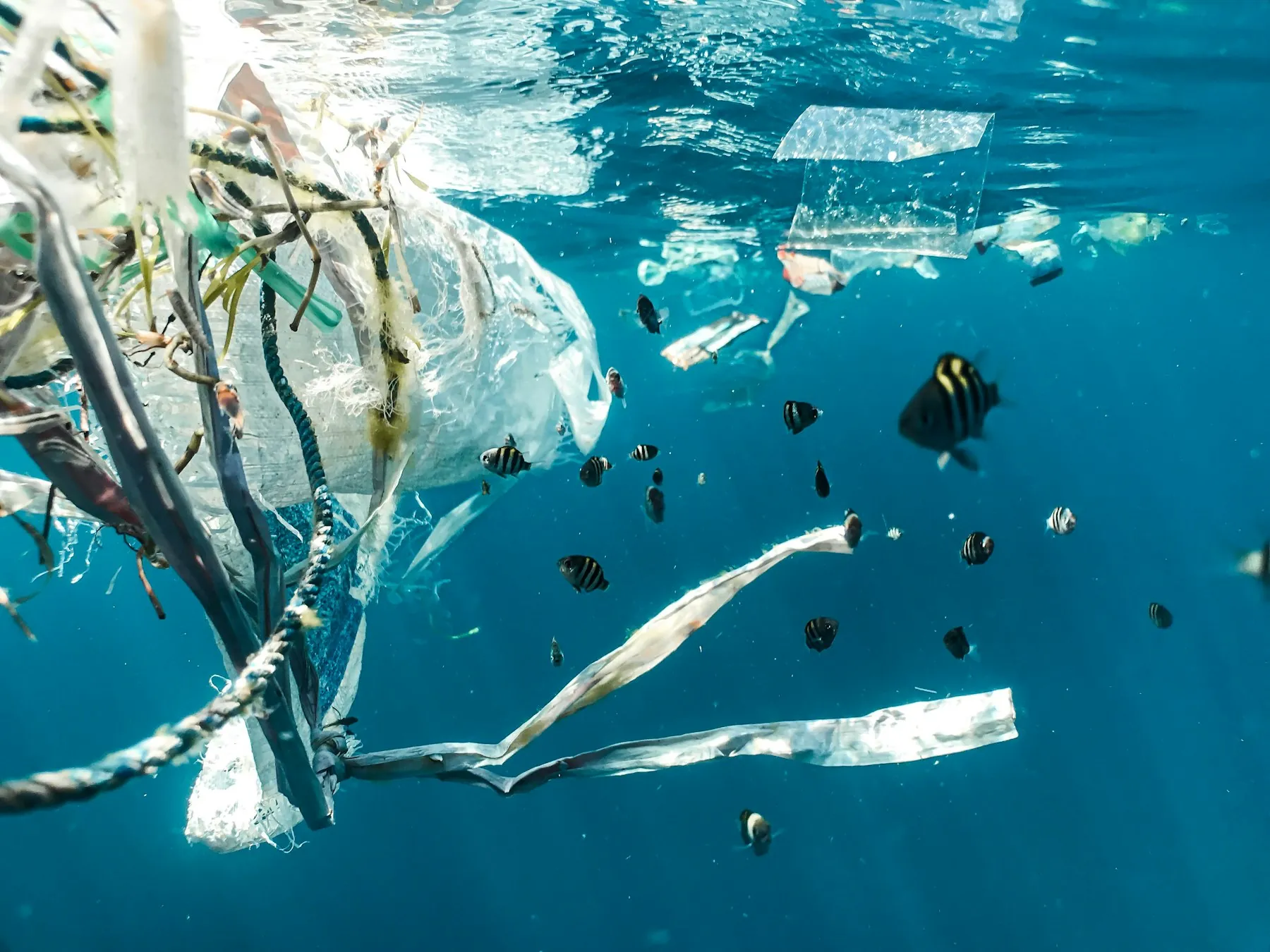
171 trillion plastic particles now float on the world’s oceans
171 trillion plastic particles afloat (2019)
About 171 trillion plastic particles (about 2.3 million tonnes) floated on the ocean surface in 2019, rising rapidly since 2005.
Eriksen M., Cowger W., Erdle L.M. et al., 2023 Verified 22 Sep 2026
- Evidence: Medium Cross-sectional
‘Plasticosis’: the first disease named after plastic
First disease caused by plastic named
Stomach scarring (fibrosis) increased with plastic load; the condition was named 'plasticosis'.
Charlton-Howard H.S., Bond A.L., Rivers-Auty J., Lavers J.L., 2023 Verified 22 Sep 2026
- Evidence: High Cross-sectional
About 2% of all fishing gear is lost at sea every year
739,583 km of fishing line lost at sea every year
Roughly 2% of fishing gear is lost each year, including 739,583 km of longline, about 14 billion hooks and more than 25 million traps.
Richardson K., Hardesty B.D., Vince J., Wilcox C., 2022 Verified 22 Sep 2026
- Evidence: Medium Cross-sectional
A floating marina bin caught 0.18 kg of litter in a month
0.18 kg of litter in 750 hours
One Seabin caught 1,828 pieces of litter weighing 0.18 kg in 750 hours, and about 13 animals a day, around 60% of them dead when the bag was emptied.
Parker-Jurd, Smith, Gibson, Nuojua and Thompson, 2022 Verified 24 Sep 2026
- Evidence: High Narrative review
914 marine species are known to have swallowed or been tangled in plastic
914 marine species affected by plastic debris
914 marine species have been recorded ingesting (701) or entangled in (354) marine debris, up from 267 in 1997.
Kühn S., van Franeker J.A., 2020 Verified 22 Sep 2026
- Evidence: High Cross-sectional
More than 1,000 tonnes of microplastic rain down on US national parks each year
>1,000 tonnes of microplastic a year fall on western US parks
More than 1,000 tonnes of microplastic a year are deposited on western US protected lands; 4% of dust particles were plastic.
Brahney J., Hallerud M., Heim E., Hahnenberger M., Sukumaran S., 2020 Verified 22 Sep 2026
Climate
Plastic is a fossil-fuel product
Around 99% of plastic is made from oil, gas and coal. Making it, and burning it as waste, released about 2.2 billion tonnes of greenhouse gases in 2019, more than the aviation industry. On current growth, by 2050 plastics could use up to a third of all the greenhouse gases the world can still release if warming is to stay within 1.5 °C.
- Evidence: Medium Institutional report
Industry data: global plastic production reached 431 million tonnes in 2024
430.9 million tonnes of plastic produced in 2024
Global plastics production was 430.9 million tonnes in 2024, up 16.3% since 2018; Asia produced 57.2%.
Plastics Europe, 2025 Verified 22 Sep 2026
- Evidence: High Model / projection
Uncollected waste and open burning, not littering, drive plastic pollution
30 million tonnes of plastic burned in the open each year
52 million tonnes of plastic entered unmanaged systems in 2020; 57% was burned in the open; 1.2 billion people lack waste collection.
Cottom J.W., Cook E., Velis C.A., 2024 Verified 22 Sep 2026
- Evidence: High Model / projection
Making virgin plastic emits 5.3% of global greenhouse gases outside farming and land use
5.3% of global greenhouse-gas emissions outside farming and land use, from making virgin plastic
Primary plastic production emitted 2.24 billion tonnes carbon dioxide equivalent (CO2e) in 2019 (5.3% of global greenhouse gas (GHG)); at 2.5% annual growth it would consume 21–26% of the remaining 1.5 °C carbon budget by 2050.
Karali N., Khanna N., Shah N. (Lawrence Berkeley National Laboratory), 2024 Verified 22 Sep 2026
Economy
The bill is already being paid
The plastic made in a single year carries a lifetime cost to society of around US$3.7 trillion, and health damage linked to plastic chemicals exceeds US$1.5 trillion every year. Most of that is paid by taxpayers, health systems, fisheries and tourism, not by the companies that make it.
- Evidence: Medium Institutional report
7 US states have packaging extended producer responsibility (EPR) laws; California bans plastic checkout bags
7 US states with packaging EPR laws
Seven US states have packaging EPR laws; California bans all plastic checkout bags from 1 January 2026; no federal plastics law exists.
Assent / Packaging Dive (industry trackers), 2026 Verified 22 Sep 2026
- Evidence: High Institutional report
England’s plastic bag charge cut single-use bag sales at the main supermarkets by 98%
98% fewer single-use bags at the main supermarkets since 2014
The 94 reporting retailers sold 399 million single-use bags in 2025/26, down 9% year on year and 81% since 2016 to 2017; the main 7 supermarkets sold 126 million, down 98% since 2014.
Department for Environment, Food & Rural Affairs (Defra), 2026 Verified 24 Sep 2026
- Evidence: Low Institutional report
Starbucks’ “widely recyclable” cups: none tracked to a recycling facility
0 of 36 tracked cups reached a recycling facility
None of 36 tracked Starbucks cold cups placed in in-store recycling bins reached a recycling facility; most went to landfill or incineration.
Russianoff N., Beyond Plastics, 2026 Verified 23 Sep 2026
Press play to load the video from YouTube (youtube-nocookie.com). Nothing loads until you do.
Watch
The Plastic Country
A full-length independent documentary by Kal Glanznig on Australia’s hidden plastic crisis: where our waste really goes, who profits, and the people fighting back. Free to watch on YouTube.
Also on our list: Plastic People: The Hidden Crisis of Microplastics (2024, free on SBS On Demand in Australia), The Story of Plastic, Plastic Wars and more.
What to do with this
Feeling alarmed is reasonable. Feeling powerless is not justified: the same evidence shows that bans work, refill systems work, and households can cut their plastic use quickly. Start with the swap that matters most for you.
Beyond your own bin: support a group working on this on Help the cause, write to a company or your representative with our template letters, or follow new laws on the policy tracker.
See also: the numbers over time on Statistics, and the materials that can replace plastic on Alternatives.